

Bolo do Caco (large batch 25 pounds of flour
Makes about 35 to 40 Bolo do Cacos
Equipment
- 1 large industrial mixer or a 15 gallon tub to mix by hand.
Ingredients
- 25 pounds flour 11.34 kilograms. (11,350 g) You could use all purpose or bread, flour I prefer bread, flour if it's available.
- 6.5 quarts warm 6 liters. (54% the weight of the flour) Use warm water, if making the bread the same day. Or cold water if you are going to allow it to ferment overnight in a cool space.
- 2 quarts sweet potato cooked and mashed. the mashed potato is 16% the wieght of the flour
- 20 tbsp yeast (dry active) (yeast is 1.5% or .015 the wieght of the flour) But only use 4 tablespoons of yeast, if fermenting overnight
- 1 cup salt salt should be is 2.5% of the weight of the flour.(280 grams per 25 pound bag of flour
Instructions
- Cook the sweet potato until very tender, then mash up the potato. This could be done up to three days ahead of time.

- Mix 6.5 quarts of warm water with the active dry yeast 1 tablespoon of sugar and the mashed potatoes. Allow this mixture to set for 5 -10 minutes. You should see some bubbles forming from the yeast.

- In a large mixture add the water yeast and mashed potato mixture with the 25 pounds of flour.
- Mix the salt into the flour mixture. For every 25 pounds of flour add 1 cup of granulated salt.
- With a mixer, kneed the dough for about 10- 15 minutes if using a large mixer. (30 minutes if kneading by hand)

- If the temperature is below 65°F allow the dough to ferment for at least four hours. If the temperature is above 75°F allow the dough to ferment three hours. (* steps 1 through 6 can be done the day before; by using 1/4 of the yeast (4 tablespoons) and allowing the dough to ferment for 10 to 18 hours overnight.

- After the first proofing/fermentation, place the dough on a large flat surface and use a bench scraper/knife to divide the dough in four equal parts.

- Roll each of the four portions into a long tube shape- about 4 inches thick.

- Cut/Divide the dough into 16/17 oz portions. Form the dough into a a ball shape shape. Then press the dough to form each portion into a disk shape. About 5-6 inches in diameter. (about 470 gram portions)

- Place each of the portions/disks on to a well floured 6- 8 inch paper plate.

- Cover the dough and allow to proof of 1-2 hours if the temperature is around 70- 80F (if the temperature is below 65-70F it may need to proof/ferment for 3-4 hours

- Cook over medium heat about five minutes on each side.

Notes
Note: you can cook the bread on each side until it is a golden brown, and then finish the bread in the oven. (when I use this method, I will cook about 10-15 bolo do cacos, on each side until golden. Then place the bolo do cacos on a large sheet pan; put them in the oven and finish cooking at 400 F for and additional 10 minutes. If you have an instant read the monitor, the bread is done if the internal temperature is between 190 and 200°F
If you don't have a large mixer, you will need a large container about 15 gallons in size to mix and kneed the dough by hand.
My preferred method of doing the first fermentation is to do it the day before you bake the bread. When I do this, I only use 1/4 of the yeast. (about 4 tablespoons for a 25 pound bag) Let the dough proof overnight in a cool place like a refrigerator or outside of the refrigerator if the temperature is going to be between 40 and 55°F)
=============
Fermenting at this cold temperature with a smaller amount of yeast allows you to ferment it for 8 to 16 hours. If the dough was proofed inside the refrigerator, allow it to warm up outside of the refrigerator for at least an hour before proceeding with step seven {dividing the dough}. (This is the preferred method because of slow and long fermentation, hot temperatures between 45 and 60°F. Develop more complex flavors, and this long fermentation helps develop the gluten.
Bolo do Caco Calculator
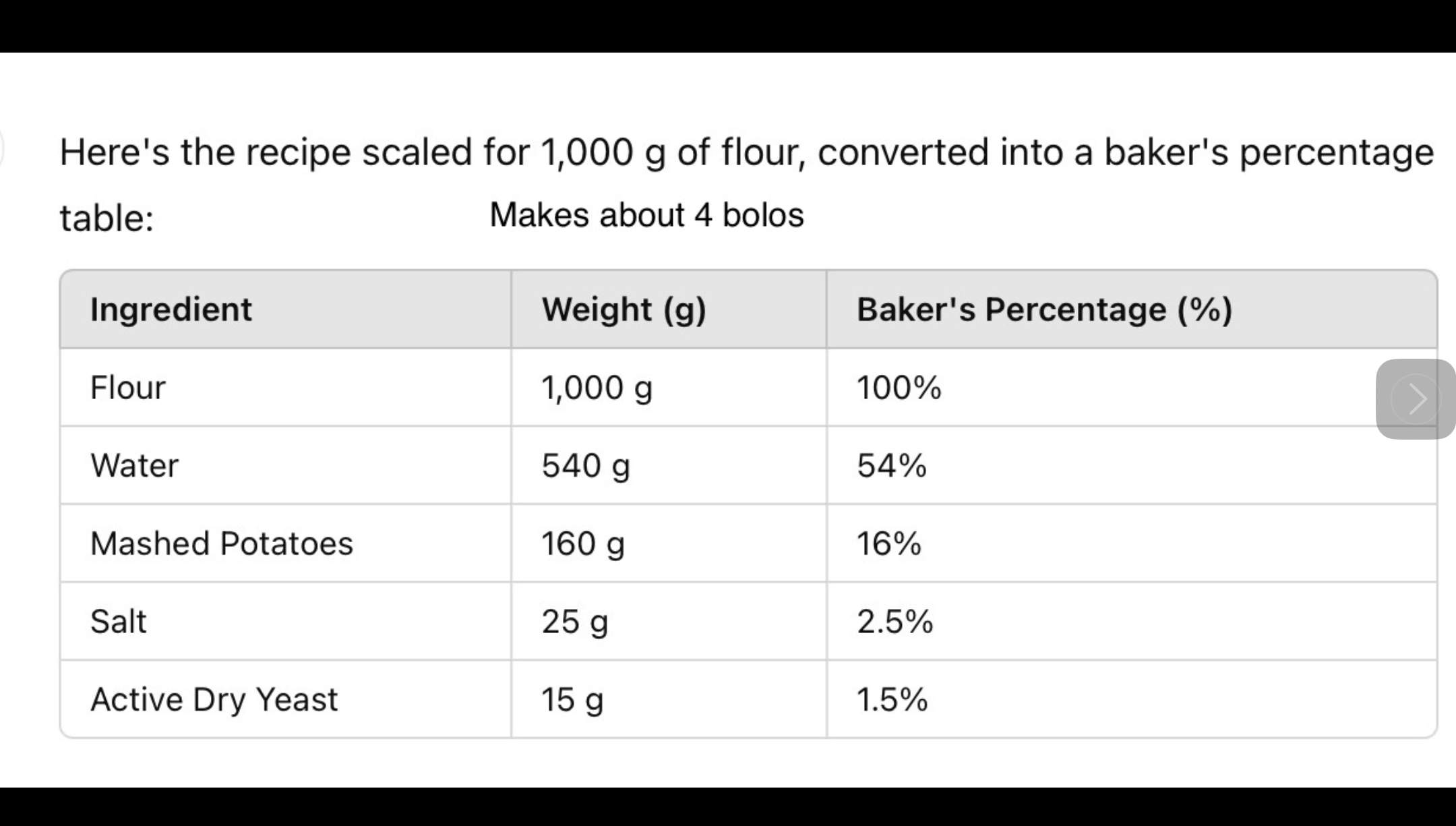 Here's the recipe scaled for 1,000 g of flour, converted into a baker's percentage table:
Makes about 4 bolos
xxxxxxxxxxxx
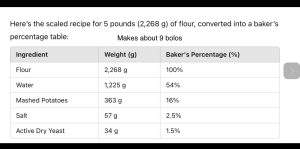
Here's the scaled recipe for 5 pounds (2,268 g) of flour, converted into a baker's percentage table:
Makes about 9 bolos
http://justcookwithmichael.com/wp-content/uploads/2025/06/ai-bolo-do-caco.pdf
Origins of Bolo do Caco
Bolo do caco is a traditional flatbread from the Portuguese island of Madeira and its neighboring island, Porto Santo. The bread is made with wheat flour, sweet potato (often white-fleshed), water, yeast, and salt, and is traditionally cooked on a flat basalt stone called a "caco," which gives the bread its name[
Where Did It Originate?
Historical sources and local tradition indicate that bolo do caco was initially created on the island of Porto Santo, not Madeira itself, with the main intention of reusing leftover bread dough at home[ Over time, it became widely popular across both islands and is now a culinary icon of Madeira as well. Both islands, however, lay claim to its origins, and the bread is now deeply associated with the gastronomy of the entire Madeira archipelago
First Known Documentation and Historical Context
Bolo do caco has roots that stretch back several centuries, with some sources suggesting its presence as early as the 15th century, coinciding with the early settlement of Madeira and Porto Santo[4]. The bread’s method of preparation—cooking on a stone rather than in an oven—was particularly significant historically. In the 1500s, private ovens were forbidden for commoners, and only the wealthy or religious orders had access to communal ovens. The use of a stone slab over embers made bolo do caco accessible to everyone, which contributed to its widespread adoption
There is no evidence of a formal, published recipe for bolo do caco from the 16th or 17th centuries, as most traditional recipes were passed down orally. However, references to the use of sweet potatoes in island cooking appear in Portuguese culinary literature by the late 18th century. The earliest Portuguese recipe book mentioning potatoes dates to 1780, but it refers generally to their use in sweets and not specifically in bread[8]. The generalized use of sweet potato in breads on the islands is likely a 19th-century development, as the potato itself was only introduced to Portugal around 1760 and promoted in the Azores by royal decree in 1798[8][
Why Is Potato Used in Bolo do Caco?
The addition of sweet potato (batata doce) to bolo do caco stems from practical and agricultural necessity. Madeira and Porto Santo historically faced shortages of wheat and other cereals due to their isolated location and challenging farming conditions. Sweet potatoes, which grew well in the volcanic soils and mild climate, became an important staple. Adding sweet potato to bread dough stretched limited wheat supplies, improved the bread’s texture, and imparted a subtle sweetness and moisture to the crumb
From a scientific perspective, sweet potato contributes to the bread’s soft, airy texture and helps retain moisture, resulting in a tender crumb and a slightly sweet flavor. The starches in the sweet potato gelatinize during cooking, enhancing the bread’s structure and shelf life. This aligns with food science principles discussed in Harvard’s food science series, where the role of starches and sugars in bread baking is emphasized for their impact on texture and browning.
Pre-1980s History and Cultural Significance
Conclusion
Bolo do caco is a product of necessity, ingenuity, and local adaptation. Its roots are in Porto Santo, but it is now a symbol of Madeiran cuisine. The use of sweet potato reflects both agricultural pragmatism and culinary creativity, making this bread a living example of how local conditions shape food traditions. Its history predates the 1980s by centuries, with its essential characteristics established by the 19th century and possibly earlier, though written recipes only appear much later
===Recommended place to purchase on Madeira Island
Here's the recipe scaled for 1,000 g of flour, converted into a baker's percentage table:
Makes about 4 bolos
| Ingredient | Weight (g) | Baker's Percentage (%) |
| Flour | 1,000 g | 100% |
| Water | 540 g | 54% |
| Mashed Potatoes | 160 g | 16% |
| Salt | 25 g | 2.5% |
| Active Dry Yeast | 15 g | 1.5% |
| Ingredient | Weight (g) | Baker's Percentage (%) |
| Flour | 2,268 g | 100% |
| Water | 1,225 g | 54% |
| Mashed Potatoes | 363 g | 16% |
| Salt | 57 g | 2.5% |
| Active Dry Yeast | 34 g | 1.5% |
- Pre-19th century: Bolo do caco’s origins are linked to the early settlers of Porto Santo and Madeira, with influences possibly from Arabic flatbreads brought by North African and Moorish contacts, as flatbread baking on hot stones is a technique found throughout the Mediterranean and North Africa
- 19th century: The widespread use of sweet potato in bolo do caco likely became common as the potato gained popularity in Portugal and its islands. By this time, the bread was already a staple of local cuisine and a marker of Madeiran identity[8].
- 20th century: Bolo do caco remained a household bread, especially in rural areas, and became increasingly commercialized as Madeira developed its tourism industry. Its preparation on a hot stone persisted as a cultural tradition, even as modern methods (like using griddles or pans) became more common
| Aspect | Details |
| Place of Origin | Porto Santo Island (Madeira archipelago), Portugal |
| First Documentation | Oral tradition from the 15th century; sweet potato use documented in late 18th century |
| Spread | Became popular on Madeira and internationally |
| Key Ingredients | Wheat flour, sweet potato (white-fleshed), water, yeast, salt |
| Traditional Cooking | On a flat basalt stone ("caco") over embers |
| Reason for Potato Use | To stretch wheat, improve texture, and adapt to local agriculture |

